Follow me on Twitter

Showing posts with label Italy. Show all posts

Wednesday, 19 October 2011

Match Report: Napoli 1 - 1 Bayern Munich

Two teams, two formations. In this Champions League Group A fixture, the contrast between the 3-4-3 of Napoli and the 4-2-3-1 of Bayern Munich determined the outcome of the result. Bayern were the better side in the game and controlled the possession of the ball, yet they seemed content to draw away to Napoli and sit atop the hardest group in the Champions League. Despite the contrast in formations, both clubs had difficulty tracking the runs from deep of opposing players, namely Christian Maggio and Toni Kroos, and also focused their play down the wings.


Line Ups:


The Game:


Bayern dominated from the first whistle and scored quickly, in the 2nd minute, from a well taken Kroos goal. Bayern passed the ball shortly and quickly, building up pace as they passed it forward, then distributed it out wide to Jerome Boateng who's low cross fell into the path of the running Kroos, who then accelerated past the Napoli defence and side footed it home.


Napoli then tried to get back in the game, using the runs of Maggio and Zúñiga out wide to fathom chances. Cavani didn't feature in the game and didn't look sharp; arguably the service towards him wasn't great but Lavezzi tried to create chances through his precise dribbling. Maggio, who earlier looked slightly wasteful, finally had a run that came into fruition after receiving a through ball from Gökhan Inler and he put the ball across the six yard box, where it was turned in by the hapless Holger Badstuber.


Bayern dominated early on in the second half, receiving a dubious penalty in the 49th minute from a Cannavaro handball. Mario Gómez missed the penalty with a poor effort and from then the game dwindled down, both teams content with a draw.


Champions League: Mario Gomez, Marek Hamsik, Paolo Cannavaro - Napoli-Bayern Munchen (Getty Images)


Passing:


Bayern comfortably controlled possession, especially in the early first half, mainly due to their one-man advantage in the middle of the field. Bayern's three central midfielders outnumbered Napoli's two and they played short passes through the middle. Eventually, however they forced it out wide to Franck Ribery or Thomas Müller. Despite this, Bayern were more patient in their passing and waited for opportunities to arrive.


Napoli, on the other hand, were far more riskier with their passing and played more directly, looking to get the ball on the wings quicker. This was helped by the passing prowess that all three of their centre backs had in sending long balls out wide. Furthermore, Napoli had only one good passer of the ball in the middle, Inler, and they looked to get the ball forward to the wings or to their front three.


Runs from Deep:


Both goals in the game came from the difficulty the teams had in tracking runs from deep. For Bayern, the main threat came from Kroos while for Napoli it was Maggio.


Kroos ran from deep in the middle of the pitch and early on, Napoli had trouble defending against this. Soon however, Campagnaro started to get forward to stop Kroos. This reduced the effectiveness of Kroos but it wasn't ideal for Campagnaro to track him as he struggled. This in theory would work, as Napoli had two spare centre backs against Bayern's lone striker and they could afford to lose one, yet it made their two-man defence very narrow and susceptible to Ribery down the flanks. Perhaps Gargano could have tracked Kroos from deep, preserving the back three of Napoli, but his marking would have been put under question.


Bayern found it difficult to prevent Maggio's runs from deep, which may in part be because most teams nowadays employ wingers further forward, cutting inside onto their stronger foot. Maggio, however, liked to send crosses without cutting in and ran from a deep position. Schweinsteiger should have prevented his runs further down the pitch but he isn't a player renowned for his defensive abilities.


Napoli Defending the Wings:


Napoli played with a three man defence and weren't protected from Bayern's wingers, especially Ribery, as they didn't have any full backs. Ribery is a modern type of winger who likes to cut inside and play further up the pitch and Napoli had problems with him. Instead of preventing him from finding any space down the flanks, they focused on stopping them from his position. The first line of defence was Maggio, who additionally to running forward, tracked back to stop Ribery. Then, the next layer of defence was the closest centre back to Ribery, in this case Campagnaro, who closed him down by playing as a full-back, leaving the other centre backs to reposition themselves more centrally. If Bayern worked harder and Ribery played to his full potential, this area would have been more decisive in the game; instead for large parts Ribery was ineffectual.


Conclusion:


An interesting game between two very different formations which fizzled out in the second half as the two teams started to play for a draw.

Sunday, 13 March 2011

Match Report: Roma 2-0 Lazio

Is there a more fiery, important and tense Italian football derby than the Derby della Capitale? Sure the Milan derby is more illustrious, but the Rome derby means so much to the fans that some supporters would use laser pens to ensure that their side receives all three points in the battle of the capital.
But more on that later.
The derby was an intense game, featuring two red cards, a penalty and a bare chested Roman running celebrating fanatically. And all of this occurred in the last few minutes. But what about the tactics of this game? After all, it is hard to not be enthralled by the ensuing action of any derby and neglect the tactics of the game, if there were any. 
This game showed how Roma struggle to defend wide players, but also how big players who regularly fail to show up throughout the season, such as De Rossi and Totti, never forget to perform for the big derby.


Starting Line Ups:


Roma:
32 - Doni
29 - Nicolás Burdisso
5 - Phillipe Mexes
4 - Juan
17 - John Arne Riise
7 - David Pizarro 
16 - Daniele De Rossi
94 - Jérémy Menez
20 - Simone Perrotta
9 - Mirko Vučinić
10 - Francesco Totti


Under Ranieri, Roma played like many Italian teams and rarely strayed from their tried and tested 4-3-1-2. Vicenzo Montella, however, has brought a sense of upheaval in a tactical sense, introducing a 4-2-3-1, similar in fact to the 'strikerless' formation Montella played under with Luciano Spalletti at the helm. 


Totti didn't play as far forward as a normal striker, but he definitely did not play as an Trequartista. Vučinić played to the left of Totti, moving around the area between him and the touchline. 


On the opposite flank, however, Menez had much more of a free role. At the beginning of the game, Menez kept to the right flank, contrary to how he normally plays for Roma. This made Menez ineffective as he works best when cutting in and playing on the right flank, he would cut into on his weaker, left foot. Later on though, he would start to buzz between the flanks as if he were a bee hesitating over which flank he would call his hive. 


Marco Borriello was kept on the bench, possibly a reaction by Montella over his hysterical actions against Shakhtar Donetsk in midweek, after he took a penalty, against his manager's orders, and missed it.


Burdisso was effectively a centre back playing wide on the ride and hence didn't provide enough attacking verve down that side. This, however, would work to Roma's advantage.  


Lazio:
86 - Fernando Muslera
2 - Stephan Lichtsteiner
13 - Guglielmo Stendardo
20 - Giuseppe Biava
26 - Ştefan Radu
24 - Cristian Ledesma
8 - Hernanes
11 - Matuzalém
77 - Giuseppe Sculli
10 - Mauro Zárate
22 - Sergio Floccari


Lazio played a similar formation to Roma, with three centre midfielders patrolling the ball. 


The difference between the two sides, however, was how Lazio used wide players more effectively. Unlike Roma, Lazio played with an out-and-out winger in Sculli and a striker who was much more disciplined in sticking out wide in Zárate.


Lazio also had a target man type player in Floccari, so they were much more enthusiastic in sending the ball up forward.


Ledesma was the enforcer in midfield, with the Brazillian duo of Matuzalém and Hernanes spreading the ball out wide. Lichsteiner provided a lot of effort going forward, but without much product.


Opening Minutes: Threats from Deep


For a Serie A match, the game started with a lot of enthusiasm and fast paced balls; the players being urged on by the loud fans. Lazio had the first chance of the game when Matuzalém fired a long range shot wide after the ball fell to him kindly after a number of deflections from a corner. One minute later on, however, Matuzalém was outdone by Pizarro, who after receiving a pass from De Rossi 35 yards out, controlled the ball and fizzed an unstoppable shot onto Muslera's crossbar. 


After those two long-range strikes, the game slowed down as more and more fouls started building up. Three yellow cards were given out in the first half, showing how much the players abandoned pre-match plans and started playing more sporadically. Hence, the game was slow with many breaks in the play.


During the first half, Roma were more inclined to build the ball up from the back, playing neat balls through the middle. Many times however, they would out do it, playing a wrong pass or miss-control the ball. One of the main reasons why plenty of teams play direct football is because short passing results in more passes being played, and more passes means that there is a greater chance of making a mistake. This was evident by the play Roma were showing as they lost the ball lots of times.


In contrast, Lazio played more directly, bringing the ball up to Floccari to hold up or introducing the ball to one of their wingers. The defensive nature of Burdisso, however, negated the trickery of Zárate on the left, and the first half ended in a stalemate.


Second Half: Lazio Improves


After half time, Lazio started to play better football, out running Roma on the wings. The game opened up and this suited Lazio better as they were the quicker, more mobile team. The biancocelesti also started to cross the ball in more, and Floccari had chances to head the ball in due to Roma's vulnerability out wide. 


Roma had their chances as well. By playing little balls in to attack, Juan found himself with the ball after a pull-back by Menez, only to see Ledesma dispossess him by swiping the ball cleanly out under his feet. 


Late in the Game: Lots of incidents


The notorious green laser

As the subtitle suggests, the closing stages of the game were full of drama. Roma, apart from the Juan chance, were shut out for most of the second half, mainly through tough defense and Hernanes becoming more influential. On the 70' minute, however, they found themselves with a free kick only twenty yards out. Only one player was ever going to take that strike: Totti. A Roma player through and through, the child of Rome lived for derbies against Lazio. An idol of the Roma supporters, he hated Lazio as much as he loved Roma. 


Before he took the kick however, Muslera's eyesight was obstructed. And it wasn't just by the humongous wall Lazio had put up. From the crowd, a Roma fan was shining a green laser into his eyes. Then Totti struck the ball. Bang. The ball swerved through the Lazio wall and under Muslera's body with such force that that alone could have been an excuse for Muslera not saving the ball. But that wasn't it. The laser pen could have disorientated the Uruguayan goalkeeper, as it was in his eyes only shortly before Totti took the free-kick. Furthermore, the Lazio wall was extremely long, so Muslera could only see the ball very late. Either way, Roma were one up.


Only four minutes later, after scrapping for the ball, Matuzalém seemingly stood on Totti's ear. The referee missed it and while Totti was wriggling on the floor, the TV replay supported his claim. Matuzalém had clearly stepped on the side of Totti's face with force. This signaled the start of an ill-tempered finale. 


From the 85' minute onwards, Roma were keeping the ball by the corner flag and winning corners repeatedly by striking the ball against Radu's shin to the corner flag. After successive corner's of keeping the ball by the touchline, Totti and Simplicio started to get under the skin of Radu and after a while, the Romanian had enough. He strutted over to the corner flag, where Simplicio was standing, and head butted him on the head. Right in front of the assistant referee. Radu was already heading off the pitch before receiving the red card and Roma had succeeded in their ploy of frustrating the Lazio players. But the drama still wasn't over.   


In the 91' minute, Totti played a ball across the penalty area towards the path of the oncoming Simplicio after a fast break. Simplicio, however, was impeded by a nudge by Biava and fell to the ground. The referee pointed to the penalty spot and the Lazio players were in uproar. Cristian Ledesma, in particular, had something to say about the decision, and was promptly sent off after a long string of complaints towards the referee. Lazio were down to nine men, Roma had a penalty and the game was effectively over. That didn't stop Totti from getting a brace by thumping the ball into the roof of the net. Muslera, again, was impeded by a green laser to his face. Nevertheless, Totti galloped over to the Curva Sud, home to the Roma supporters, and started celebrating manically with his shirt off. Seconds later, Totti was substituted and handed a yellow card for his antics. All in a good days work.     

Monday, 7 February 2011

The Decline of Sampdoria

Courtesy of www.acmilan.com
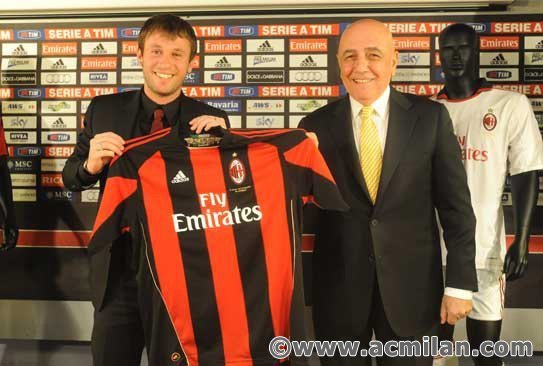
If a team loses its best player, it will impact them greatly. If a team loses its best two players, however, they are destined to struggle until they buy suitable replacements. Sampdoria find themselves in the latter position. With Antonio Cassano leaving the club to Milan after a foul mouthed tirade at club president Riccardo Garrone and Giampaolo Pazzini off to a resurgent Inter, Sampdoria have in return bought misfiring Massimo Maccarone and Federico Macheda on-loan, two players who have scored between them three goals in competitive football this season. Despite the fact that Sampdoria haven't scored a single goal in six Serie A matches, there still is hope for them in the path that lays ahead.


It is impossible to overestimate the importance of Pazzini and Cassano to last year's Sampdoria side. The two strikers formed the fulcrum of the team, almost leading them to the Champions League by finishing fourth in Serie A last season. 
In Cassano, Sampdoria had a creative talent, a mercurial player who could create chances out of nothing, who could severe a defence with a single piece of skill or a pass. Some even considered him the best Italian player last season, especially as the Cassano-less Italy squad finished last in their World Cup group which featured the likes of Slovakia and New Zealand; believed to be easy pickings for the reigning Champions. 
While Cassano played in a withdrawn role to the left of the Sampdoria attack, his forward partner, Pazzini, played as a natural goalscorer. Cassano created chances. Pazzini took them. A player with great finishing abilities, Pazzini was also clever in his positioning to create himself the best scoring opportunities. 
With these two players, Sampdoria looked again like the 1991 Scudetto-winning side, banishing the memories of Gianluca Vialli and Paolo Mancini away. Sampdoria were finally good again. Finishing fourth was a cause for major celebrations in one half of Genoa. This footballing Renaissance didn't last forever and the beginning of the end of it started at an awards ceremony.


At the awards ceremony in October, Sampdoria chairman Riccardo Garrone apparently invited Cassano to come and speak for an award he was about to  receive. Cassano refused, saying he had other commitments. Later, Garrone asked Cassano at the training ground dressing rooms on why he had refused to come to the awards ceremony, as it had embarassed him to give an award to player who wasn't there and seemingly didn't care about the award. Cassano, who after making his name as the food crazed love-rat at Roma, started swearing at him, according to Garrone, calling him a 'fat s**t' among other profanities. Cassano denies these allegations, but Garrone stayed unmoved and appealed to the Italian court of justice to have Cassano's contract rescinded, which was eventually rescinded from January 2011 onwards with Sampdoria having to pay 50% of the rest of his contract. A free agent, Cassano moved to Milan to join up and form a strike patnership with other controversial players, Zlatan Ibrahimović, Robinho and Alexandre Pato.

With Cassano gone, Pazzini also left, joining Inter for a reported £15 million and Jonathan Biabiny. On his debut for the Nerazzurri, Pazzini came on as a substitute at halftime with Inter losing 2-0 and subsequently scored two goals and scored a penalty which Samuel Eto'o dispatched for the Inter comeback.


The loss of Cassano and Pazzini has left Sampdoria considerably short of fire power this calendar year. In their last six games, Sampdoria have only gained one point (a 0-0 draw with Juventus) and have scored no goals. Nothing. And its not suprising. Sampdoria now have to rely on Maccarone, who for all his substitute heroics for Middlesbrough isn't a regular goalscorer, and Federico Macheda, who has only scored four goals in his proffesional career. Sampdoria have now slipped to 14th place, a shadow of the team they once were.


Now would usually come the natural end of this article. But it isn't over. Because Sampdoria have something rare which other Italian teams don't possess. A talented youth section. With Vladimir Koman and Andrea Poli Sampdoria have their midfield sorted for the next few years, with the former providing a powerful engine and the former a long term replacement for team stalwart Angelo Palombo. Furthermore, the Pazzini sale brought Jonathan Biabiny, a French winger with electric pace and a player who feautured for the Inter team regularly this season. Sampdoria also traditionally have been a team which take risks. This can be a bad thing, but since many Italian have been reluctant to play youngsters or vary their formations (it is a proffession in Italy, not just a game as we see it) Sampdoria can set themselves away from the crowd and provide something different. And they might just be successful! But don't count on them winning anything for the time being.

Monday, 15 November 2010

Internazionale 0 - 1 AC Milan

In the Derby della Madonnina, Milan won 1-0 thanks to a penalty from Zlatan Ibrahimović against his former club. The match was a bad tempered one, with Ignazio Abate sent off for pushing Goran Pandev in the 60th minute.


Starting Lineups:
Internazionale:


12 - Luca Castellazzi
2 - Iván Córdoba
6 - Lucio
23 - Marco Materazzi
26 - Cristian Chivu
5 - Javier Zanetti (C)
4 - Dejan Stanković
20 - Joel Obi
10 - Wesley Sneijder
9 - Samuel Eto'o
22 - Eto'o Milito


Due to injuries to Júlio César, Maicon, Walter Samuel, Thiago Motta and Esteban Cambiasso, Rafael Benítez had no choice but to field a weak side, with players like Joel Obi being pushed into the senior side. Iván Córdoba was picked in front of Davide Santon, meaning there was no attacking presence down the right flank. Benítez decided to play a 4-3-1-2 formation, with Wesley Sneijder in the 'hole' instead of the regular 4-2-3-1 formation Inter have been using for the last couple of years.


AC Milan:


32 - Christian Abbiati
20 - Ignazio Abate
13 - Alessandro Nesta
33 - Thiago Silva
19 - Gianluca Zambrotta
8 - Gennaro 'Rino' Gattuso
23 - Massimo Ambrosini (C)
16 - Mathieu Flamini
10 - Clarence Seedorf
70 - Robinho
11 - Zlatan Ibrahimović


Massimiliano Allegri left out Ronaldinho in his team and decided not to risk Andrea Pirlo's fitness, so he instead played with three 'workers' in midfield, in Gattuso, Ambrosini and Flamini. The main width from the team came from Ignazio Abate and Gianluca Zambrotta running from defence, while sometimes Clarence Seedorf moved to the left flank to get possession of the ball.


Early Minutes and Milan Goal:
Milan were by far the more dominant from the whistle, with Zlatan Ibrahimović most influential in the game. Milan tried to play long through balls from midfield for Robinho and Ibrahimović to run on to, and it was through that tactic that Milan won a penalty. Ibrahimović ran on from a long ball from midfield and when he arrived in the penalty area, he pulled the ball back but was tripped by Materazzi's trailing leg. Ibrahimović confidently dispatched the penalty, firing it to Castellazzi's left. From then on Inter failed to get into the game to give enough support to Milito and Eto'o. Furthermore, Inter had no width in their play, with two fairly defence-minded full-backs (Córdoba and Chivu) and with no winger in their team. To fill in those spaces out wide, Eto'o pulled to the left, but that left Milito alone up-front and he was surrounded by Milan defenders. Ibrahimović meanwhile was having a great game, joining play by dropping deep when Milan were in possession, in essence providing an extra midfielder for the side. However, when Milan weren't in possession, he would stay on the offside line (which Inter were implementing horribly, especially as Materazzi was never quick as a young player, let alone as a 37 year old) to receive through balls. Milan would then put balls over the top of the defence for the two front men to make something out of. 


Half Time Changes:
Before half-time, Benítez put on Philippe Coutinho on for the injured Obi. Goran Pandev came on for the ineffective Milito at the break and in the 68th minute Jonathan Biabiny replaced the injured Marco Materazzi. Zanetti was brought to right back with Córdoba as a centre back, while Coutinho played in the middle with Stanković behind the trio of Biabiny, Sneijder and Pandev. Eto'o played as the lone front man. These changes enabled Benitez to play a 4-2-3-1, which is what the Inter players are used to and also allowed more width in their play with the introduction of two wingers. Inter took to the game and were helped by a controversial incident in the 60th minute. After a foul, Abate hurried to get the ball from Pandev's grasp. This angered the Macedonian, who pushed Abate to the floor, who immediately got up and subsequently pushed Pandev back. Pandev was given a yellow-card while Abate was sent off and the former was very lucky to stay on the pitch as there was no difference in the offence committed between the two. Despite the one-man advantage, Milan defended solidly and hung on to the precious three points to stay clear at the top of the table.


Statistics:
Inter                          Milan
57%  Possession         43%
10     Shots                6
3      Shots on Target  1
4      Corners             4
12    Fouls                17
1     Yellow Cards      4

Wednesday, 10 November 2010

AS Roma 3 - 2 Fiorentina: Match Report

On a rainy day in Rome, Roma secured all three points in a game they never looked like relinquishing,despite the close scorline, thanks to goals from Simplicio, Borriello and Perrotta. Siniša Mihaljović continues his fairly poor start to his Fiorentina managerial career with a lacklustre performance from his side.


Starting Line Ups:
AS Roma:
                                                                         Júlio Sérgio


                      Cicinho                      Mexès                                   N. Burdisso                Riise
                                                                          De Rossi
                                                    Simplício                                        Greco 
                                                              
                                                            Totti                         Menez
                                                                          Borriello
Roma played with a formation that vaguely resembled a 4-3-2-1 formation (Christmas Tree), however Totti's and Menez's positions weren't strictly defined, with Totti wandering into space and dropping deep to collect the ball, while Menez would flit from flank to flank, wandering his way around the pitch. De Rossi sat deepest of the midfield trio, winning the ball and spraying it out wide, where Cicinho and Riise regularly overlapped.


Fiorentina:
                                                                           Boruc


                   De Silvestri              Gamberini                                 Natali                  Pasquale
                                                        
                                                            Donadel
                                                                                     Santana
                              Marchionni                                                                 Vargas


                                                              Mutu                     Gilardino


Fiorentina played a 4-4-2 formation, with Donadel playing behind Mario Santana, a normal winger. Marchionni and Vargas didn't play out wide as regular wingers, but still ran down the right and left flanks respectively. Mutu regularly dropped back to collect the ball, leaving Gilardino out on his own up front.


Early Minutes:
Roma controlled possession from the off, passing the ball about with their midfield three, as they had an extra man in the centre of midfield. While this enabled them to have the majority of the ball, it also meant that they could not play with wingers, so they instead relied on width from the overlapping runs of Riise, and to a lesser extent, Cicinho. The Norwegian received much of the ball on the left flank in the opening twenty minutes, but the quality of his crossing was poor, often failing to beat the first man. Another way in which Roma tried to attack was by putting balls down the left for Borriello to run for. This resulted in a chance for Borriello to score in the 11th minute, but he dragged his shot wide. The greatest threat for Fiorentina was down the left flank, where Vargas, Pasquale and Gilardino connected well, playing little triangles. Vargas was particularly a threat to Roma, running right down the throat of the Roma defence, especially as Cicinho's positioning looked questionable at times. In the 27th minute, Santana's long range strike was fumbled by Júlio Sérgio and it took a good tackle from Nicolás Burdisso to deny Gilardino from tapping in an easy goal. 


Roma Breakthrough:
Roma gave the game a breath of fresh air when in the 45th minute, a driven shot by Riise from the left of the penalty area deflected of Borriello and found its way to Simplício, who simply tapped it in from close range. Until then, the game was played at a laboured pace, but now that Fiorentina had to score they pushed on in the second half which led to a more open game.


Changes in the Second Half:
Francesco Totti had a horrible game from the off, where in the second minute he miss-kicked the ball from twenty yards out. His passing was woeful, spraying them off target, which could only be described as resembling a sawn-off shotgun. Despite this, a fabulous cross field pass from Totti found Menez on the right flank, where he dribbled past Pasquale and squared the ball for Borriello to finish into the net. Roma started to sit back on their lead, but a substitution from Siniša Mihaljović changed the game in Fiorentina's favour. In the 60th minute, Mihaljović put on his compatriot Adem Ljajić for Vargas, whose influence on the game by now had diminished. Santana was pulled to the left with Ljajić replacing him in the middle. The player from Novi Pazar added a directness to Fiorentina's attack with his trickery and Mihaljović's substitution paid off in the 69th minute, where Gilardino side-footed a Ljajić cross from the right. Fiorentina's hopes of pulling level, however, diminished when Simone Perrotta scored a freak-goal in the 77th minute.


Boruc Mistake:
Phillipe Mexès cleared the ball from his own half, where the workman-like Perrotta chased hard for it. Boruc came out of his goal to clear the ball, but when attempting to kick the ball away, he miss-kicked it as the ball bounced underneath his foot. Its worth seeing on YouTube. Perrotta ran onto the ball and capitalised by slotting the ball past Gamberini into the net. Fiorentina pressed while Roma looked potent on the break, with Daniele De Rossi pumping the ball forward for Borriello to run on for. Fiorentina were also sloppy in possession in their own half, where Borriello often won the ball back for the Romans. Fiorentina pulled a goal back when D'Agostino scored a fabulous goal from a free-kick from 20 yards in the 89th minute. He curled the ball into the top corner, leaving Júlio Sérgio routed to the spot. However, it only proved to be a consolation goal as Roma held on for the victory.


Statistics:
45' Simplício Goal     1-0
51' Borriello Goal       2-0
69' Gilardino Goal      2-1
77' Perrotta Goal       3-1
89' D'Agostino Goal   3-2


Roma                             Fiorentina
60%       Possession       40%
15          Shots                9
8           Shots on Goal    4
6           Corners              5
2           Offsides             4
9           Fouls                11
1           Yellow Cards     3